Imagine walking into a Target where the shelves subtly rearrange themselves to display products most relevant to you, while hiding things you aren’t interested in.
In a physical store, shelves are fixed. But in the digital world, layouts can evolve.
Today, most page layouts are manually designed but largely static after launch. Improvements rely on slow, one-off A/B tests.
But every scroll, click, and search is a signal we can learn from. This led us to ask: What if the full page could continuously learn from how it is used and adapt its layout in real time?
To answer that, we built an AI-powered, learning-based layout system that uses contextual bandits to personalize the page for each guest. Compared with a static baseline, the learning-based system increased click-through and add-to-cart rates and generated an estimated $50 million lift in incremental demand.
This work is part of a broader initiative to move from configurable experiences to adaptive ones, evolving our Configuration-Driven User Interface (CDUI) toward an AI-driven User Interface (AIUI).
Limits of Traditional Page Optimization
Most layout decisions today rely on A/B testing. A layout is proposed, built, and traffic is split for days or weeks. Eventually, one version wins and becomes the new default.
That approach works, but it comes with real constraints. It assumes guest preferences are relatively stable, and it relies on manual experimentation cycles that take time to design, run, and analyze. The challenge grows quickly as the number of possible layouts increases.
Target's digital pages are modular, composed of recommendation carousels, promotional banners, purchase modules, item details, and more. Even reordering a small set of these modules creates many potential layouts.
Now layer in the reality that Target operates across many distinct product categories, each with different guest intent, seasonality, and business goals. So what works for Electronics may not work for Beauty, Grocery, or Home.
At this scale, testing layouts one experiment at a time becomes impractical. This is where a learning system becomes valuable.
A Learning System for the 'Next Click'
Our approach treats page layout as a continuous optimization problem, not a fixed design decision.
Instead of asking, “Which layout is best overall?” we ask: “Which layout is most likely to work for this guest, for this item, on this page, right now?”
To do that, we use contextual bandits, a class of algorithms that learns from each interaction and adjusts content placement in real time. This lets the page improve continuously without long-running experiments or constant manual tuning.
In the initial use case, we focus on recommendation carousels, one of the modular building blocks of the full-page layout.
Architecture summary
We tested the model on traffic-aware product detail pages, which are product pages reached via external traffic such as search engines or social media.
The system uses a LinUCB-based policy, modeling expected reward as a linear function of contextual features derived from item and guest data and guest context. Every arm of the model corresponds to a recommendation carousel.
Each arm maintains its own ridge regression statistics and selects modules using an upper confidence bound to balance exploration and exploitation.
The model is deployed as a low-latency Python microservice, integrated via gRPC with Kubernetes autoscaling, and achieves p95 inference latency under 25ms.
The system architecture is shown below.
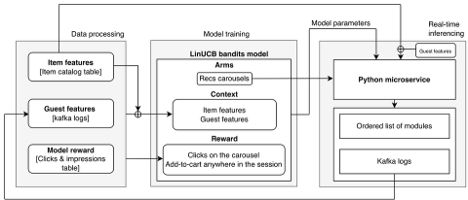
Traffic aware – AIUI architecture
Summary of Results
When we evaluated the learning-based layout system against a static baseline, it outperformed across key engagement and demand metrics:
- Statistically significant lift in click-through rate across platforms
- Increased add-to-cart activity across platforms
- Estimated $50M lift in incremental attributable demand
The learning dynamics were just as important. In the first couple of days, the system explored a range of carousel arrangements. Within days, it began converging on carousels that drove deeper engagement, while continuing to adjust as context shifted.
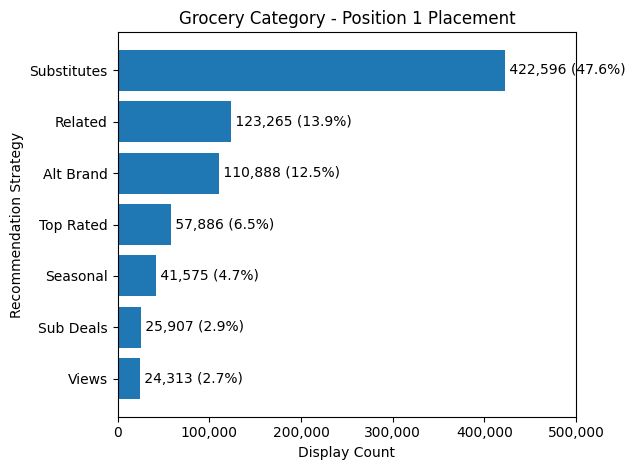
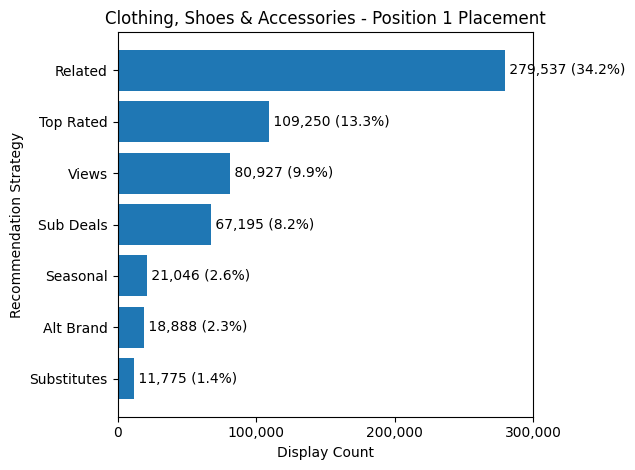
- The top carousel in frequency categories heavily favors the best substitutes, while there is more variety across discretionary categories (see comparison between Grocery position 1 and clothing, shoes & accessories position 1 in graphs below).
- Across categories, we are seeing high engagement with our recommendation strategy highlighting items viewed in the same session by other guests, elevating a carousel that was previously much lower on the page. The model demonstrates rapid adaptability to changing guest preferences, indicating the potential for a long-running solution that continues to react to the guest with no manual adjustments.
By allowing layouts to adapt in real time, guided by user interactions rather than static assumptions, we can build experiences that are more responsive, more relevant, and continuously optimize toward measurable outcomes.